
Architecture Matters: Exploring the Power Platform Well-Architected platform

Microsoft’s Power Platform Well-Architected guide is a resource intended to become a must-have tool for Power Platform development. A solution that provides best practices, architectural guidance and review tools to help make decisions about workload design, planning and implementation.
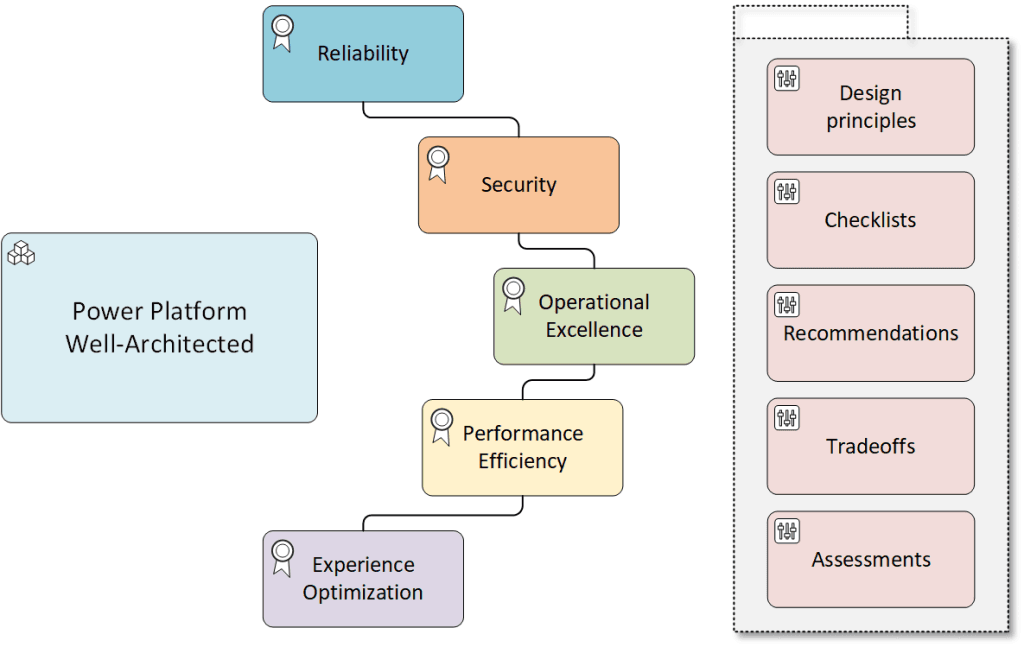
What are the objectives of Power Platform Well-Architected?
The main objective is, as with any guide, to help us achieve success. In this case, we talk about success with modern application workloads built with Microsoft Power Platform, having as goals:
- Right design: Good design leads to right execution, enabling smart decisions to be made.
- Confidence in the results: Based on real customer experiences and the expertise of Microsoft solution architects.
- Recognise trade-offs and risks: Helps you realise that following recommendations may involve trade-offs against other pillars. It shows disadvantages and possible risks in the short term.
- Improve over time: Intended for iterative use and as a tool for continuous improvement. It assesses the maturity of the workload and ensures that the design remains efficient and effective in meeting business objectives.
Well-Architected Power Platform Pillars
The pillars of good architecture are areas of focus that will help us achieve workload success. Of the five pillars, the first four are based on Azure Well-Architected. The last one (experience optimisation) is specific to Power Platform Well-Architected.
Below, we list the key pillars and their design principles:
Reliability: Resilience, availability, recovery.
- Design for business requirements: Understanding and documenting business needs.
- Design with resilience in mind: Detect failures and continue to operate.
- Design for recovery: Develop detailed recovery plans.
- Design for operations: Continuously monitor for problems.
- Keep it simple: Reduce unnecessary complexity.
Security: Data protection, threat detection, mitigation.
- Plan your security preparedness: Assess risks and develop mitigation strategies.
- Design to protect confidentiality: Implement strict access controls.
- Design for integrity: Validate data and perform regular audits.
- Design for availability: Design systems with redundancy and recovery.
- Maintain and develop your security posture: Update systems with the latest patches.
Operational Excellence: Holistic observation, Fusion + DevOps practices.
- Adoption of a Fusion + DevOps development culture: Encourage collaboration between development and operations.
- Establish development standards: Define and follow coding standards.
- Improving operations with monitoring and insight: Implement monitoring and logging solutions.
- Deploy with confidence: Perform incremental deployments and testing.
- Automation for efficiency: Automate repetitive tasks and operational processes.
- Adopt secure deployment practices: Integrate security into every phase of development.
Performance efficiency: Scalability, meeting usage demand.
- Negotiate realistic performance targets: Define clear targets based on business needs.
- Design to meet performance requirements: Select appropriate services to meet objectives.
- Achieve and maintain performance: Implement solutions that protect against degradation.
- Improve efficiency through optimisation: Use metrics to identify areas for improvement.
Experience optimisation: Usability, relevance, composition.
- Design for the user: Create fluid, intuitive and meaningful experiences.
- Design with simplicity: Reduce unnecessary complexity.
- Design for efficiency: Optimise processes to minimise costs.
Workloads
Workloads in Power Platform Well-Architected refer to a set of application, data and supporting infrastructure resources that work together to deliver desired business outcomes.
These workloads include application and technology components, as well as development and operational processes. Work teams collaborate to ensure the success of the workload.
Characteristics of a Workload
- Requirements: Describes what the system must do and how it must do it, ranked by importance to achieve a goal.
- Design: Uses resources and design patterns, considering trade-offs to meet requirements.
- Construction and Operation: Builds and operates according to design and purpose specifications.
- Measurement: Evaluates how well it fulfils its purpose.
- Adaptability: Can be adjusted as its purpose is refined or changed.
- Reliability and Safety: Is as reliable and safe as necessary.
- Responsible Development and Operation: Develops and operates in a responsible manner.
- Performance: Fulfils its purpose in an acceptable time.
- User Experience: Provides an experience that ensures the success of users.
Workload Teams
A workload team should include members with a wide range of technical and business disciplines. The primary focus of all members should be the success of the workload.
Implementation Recommendations
Microsoft also provides a tool called ‘Power Platform Well-Architected assessment’. This comprises a series of questions based on the key recommendations described in the Power Platform Well-Architected pillars.
When to conduct the evaluation?
- New workloads: Conduct the evaluation during the initial design process, recording proposed decisions. The guidance acts as a reference point and initiates a feedback loop to refine the workload design. Capture design decisions periodically at subsequent evaluation milestones.
- Existing workloads: Review as part of the workload continuous improvement cycle. Establish a cadence, for example every 90 days, and use milestones to track improvements.
Receive and integrate recommendations
After completing an assessment, recommendations for the current milestone will be available for export and sharing. These recommendations will need to be added to the pending workload work to be integrated into the software development lifecycle (SDLC).
Prioritise and implement recommendations
Workload owners and key stakeholders should rank recommendations according to the team’s standard processes for prioritising work. Before integrating them into the lifecycle:
- Consider the relevance of each recommendation and potential trade-offs associated with specific design choices.
- Assign certain recommendations to designated owners, while others may be delayed or rejected.
Monitor improvements
Finally, it should be noted that the workload will evolve due to changes in functionality, reduction or accumulation of technical debt and any necessary trade-offs. The milestone function of the evaluation will be used to track these changes, using the previous milestone as a reference point.