
Discover the best estimation techniques for agile projects

Over the last decades, the Agile methodology has established itself as an effective response to the need for rapid and continuous adaptation demanded by customers and the market itself. This technique is perfect for completing all the tasks of a project accurately and effectively.
WHAT DO WE MEAN BY TASK ESTIMATION TECHNIQUES?
Task estimation techniques in Agile projects are not only a planning tool. They also serve as a guide for informed decision making and efficient project management. It is critical to provide a clear understanding of the effort and time required. In that way, the various project tasks are completed. Teams can then make informed decisions and stay aligned with the client’s objectives. Accuracy is essential to ensure realistic planning and resource allocation. In fact, it contributes to the delivery of high-quality products.
In this article, we will explore the details of the best task estimation techniques in Agile projects. Want to know what they are? Read on!
STORY POINTS
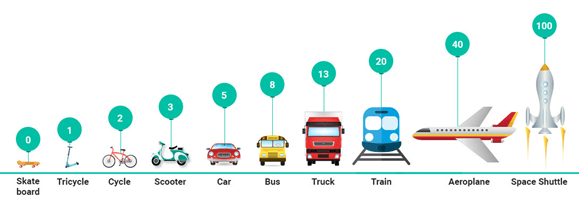
Story Point Estimation is a technique that assesses the effort required to complete a task. Specifically, it focuses on assessing the complexity and effort of a specific action, rather than determining its duration in hours or days. In this case, teams assign story points based on perceived complexity, risk and other factors that may influence the task.
These points are usually represented by numerical values such as 1, 2, 3, 5, 8, 13, etc., reflecting the effort required to complete the task. The higher the number of Story Points assigned to the task, the longer the duration of the task.
Story Points | Duration |
1 | 2 hours |
2 | 4 hours |
3 | 8 hours |
5 | 1-2 days |
8 | 3-5 days |
Planning Poker
In this method the team meets to estimate the effort and complexity of the tasks in a collaborative manner. It relies on the collective experience and knowledge of the team to arrive at more accurate and realistic estimates. It is named after the cards that each person in the team has to make proposals.
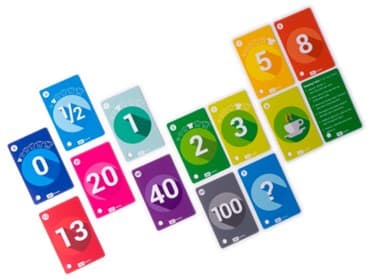
These cards represent a defined amount of time before the estimation session. They can be used as in the Story Points representation or as the number of hours the card represents. The numbers are obtained from the Fibonacci sequence. Therefore, the greater the complexity of the task, the greater the uncertainty in the estimation of its duration.
Finally, when all team members have selected a chart, they are revealed simultaneously. If the estimates agree, that value is taken as the final estimate. However, if there are significant discrepancies, a discussion is initiated to understand the reasons behind each estimate. Only then will a consensus be reached. During this stage, team members explain their reasoning behind their estimates and discuss any points of confusion or disagreement. The goal is to reach a collective consensus on the final estimate, which reflects the understanding needed to complete the task.
T-Shirt Sizing
The T-Shirt sizing estimation technique uses T-shirt sizes (XS, S, M, L, XL) to represent the complexity of tasks in a software development project.
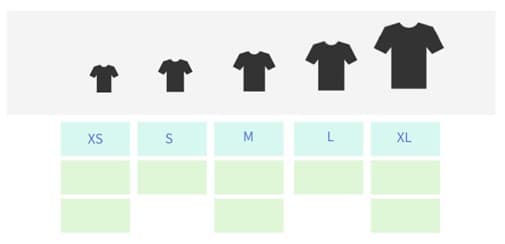
T-Shirt sizing is a simple and visual methodology that allows to quickly evaluate the complexity of tasks. It is not necessary to assign specific numerical values. This method claims that it is easier to compare sizes (such as XS, S, M, L, XL) than to assign specific numerical values. By classifying tasks into T-shirt size categories, the team can reach consensus faster.
After each team member has suggested a T-shirt size for the task, a discussion is held to reach a consensus.People reason their choice and consider different perspectives before arriving at the final decision.
Once each task has been estimated, the team can use this information to plan work based on their capacity and project priorities. Ultimately, the simplicity and visualization provided by T-Shirt sizing facilitates collaboration and informed decision making during the planning process.
What should you take into account when performing task estimation techniques?
Here are some tips on how to perform task estimation techniques to perfection:
- Understand the project context: Before starting any estimating task, it is crucial to understand the project context and requirements. This includes understanding the customer’s objectives, functional and non-functional requirements. As well as any time or resource constraints.
- Involve the entire team: Task estimation in Agile projects must involve the entire team. Developers, testers, analysts and other relevant stakeholders are included. Diversity of perspectives helps ensure a more accurate and complete estimate.
- Define clear acceptance criteria: Before estimating a task, it is important to have clear and well-defined acceptance criteria. These set expectations about what is expected to be accomplished and help the team better understand its complexity.
- Review and adjust estimates regularly: Estimates in Agile are dynamic. They can change as more information is obtained about the tasks and the overall project. It is important to review and adjust estimates regularly to reflect any changes. If any changes are made during development to the estimates, the task should be reconsidered to avoid problems later.
- Conduct retrospective sessions: Analysis of past estimates can provide valuable lessons for improving future estimates. Agile teams should periodically review their past estimates to identify patterns, trends and areas for improvement.
By following these general recommendations, Agile teams can improve the accuracy and effectiveness of their task estimates. This will enable them to plan and manage projects more efficiently and successfully.
Do you want to know more about task estimation in Agile projects? Don’t hesitate, contact us and let us know all your doubts.