
How to choose wisely in software testing: smart keys and strategies

Software development is a constantly evolving, dynamic universe facing increasingly complex challenges. According to recent statistics, 80% of software projects encounter significant issues during their lifecycle. Therefore, effective software testing is essential for the successful development of increasingly complex projects.
In this article, we’ll explore general guidelines and essential strategies for ‘Wise Selection’ when conducting software testing, whether in the realm of unit, integration, or end-to-end testing.
Fundamental Patterns in Testing Contexts
There are specific patterns and critical aspects crucial in unit, integration, or end-to-end testing. These principles apply and should be implemented in both types of tests, establishing a solid starting point.
Prioritizing Simplicity: Key in the Testing Process
When delving into test creation, the prevailing maxim is simplicity. Following Yoni Goldberg‘s ‘Golden Rule,’ software tests should be assistants, not complicated mathematical enigmas. The aim is to ensure the intent is evident at first glance.
Avoiding Unnecessary Complexity in Advanced Testing
The pursuit of simplicity isn’t solely a mantra for basic testing; it becomes more crucial as tests grow complex. Imagine a test as a quick guide for identifying and rectifying issues, keeping it simple and understandable.
Simplification and Significance in Testing
Flat test designs not only simplify but also ensure each test holds significance. Avoiding the trap of creating tests solely for coverage is crucial. Each software test must have a clear purpose and contribute to the overall software quality.
Implementation Details: Focusing on User Experience
A common mistake in software testing is delving into implementation details unknown or unused by end-users. Here, adopting the user’s perspective is crucial. Planning tests considering their interaction rather than implementation details. Opting for less prone-to-change selectors, such as using data attributes over CSS selectors, can significantly enhance test reliability.
Characteristics of a Good Test
A good test is one that meets the quality, reliability, and efficiency objectives of the software being developed. However, not all tests are the same, nor are they applied uniformly in all contexts. There are different types of tests that adapt to the needs and characteristics of each project, each with its own advantages and disadvantages. In this section, we’ll differentiate among the three most common types of tests: unit tests, integration tests, and end-to-end tests. We’ll explore what makes a test good in each of these cases and how we can apply them effectively
Unit Testing
Unit tests validate that each software unit functions as expected. A unit is the smallest testable part of an application.
In the realm of unit testing, using mocks to simulate dependencies becomes a valuable practice. This should be balanced between validity and excess, not compromising test quality or making it overly complex. The ability to create fake data or components isolates the unit under test, improving predictability and error identification. However, balance is key; excessive use of mocking can distort reality and reduce test confidence.
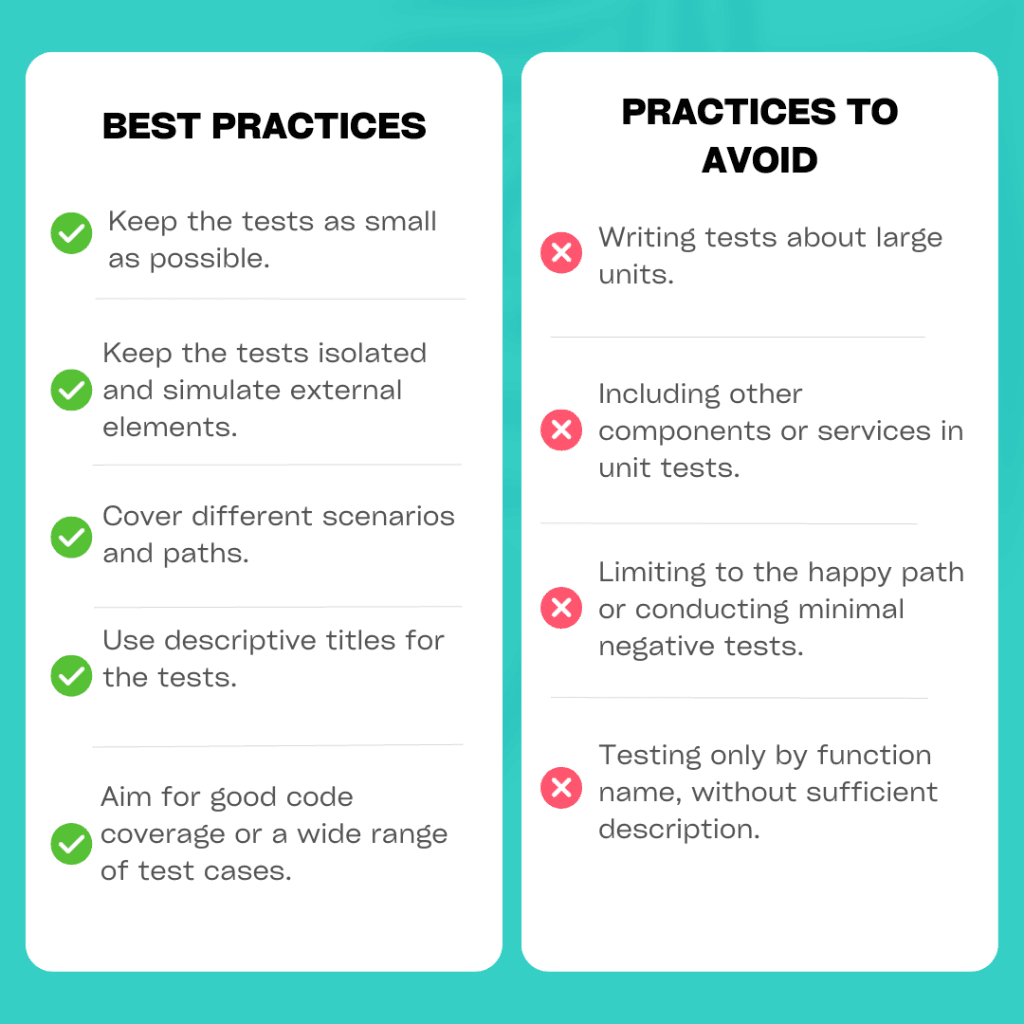
Characteristics of a Good Unit Test:
To ensure comprehensive test coverage, it’s important to focus on specific aspects and operate independently. Including small-scale scenarios and using descriptive names are also recommended practices. Following the AAA pattern, if applicable, can benefit test quality. It’s important to remember:
Integration Testing
Integration tests ensure that software components or functions operate together correctly and cohesively. These tests are conducted after unit tests, which verify each component’s isolated functionality. The aim of integration tests is to detect and resolve potential errors arising from combining different software components. They also evaluate the performance and quality of the integrated system.
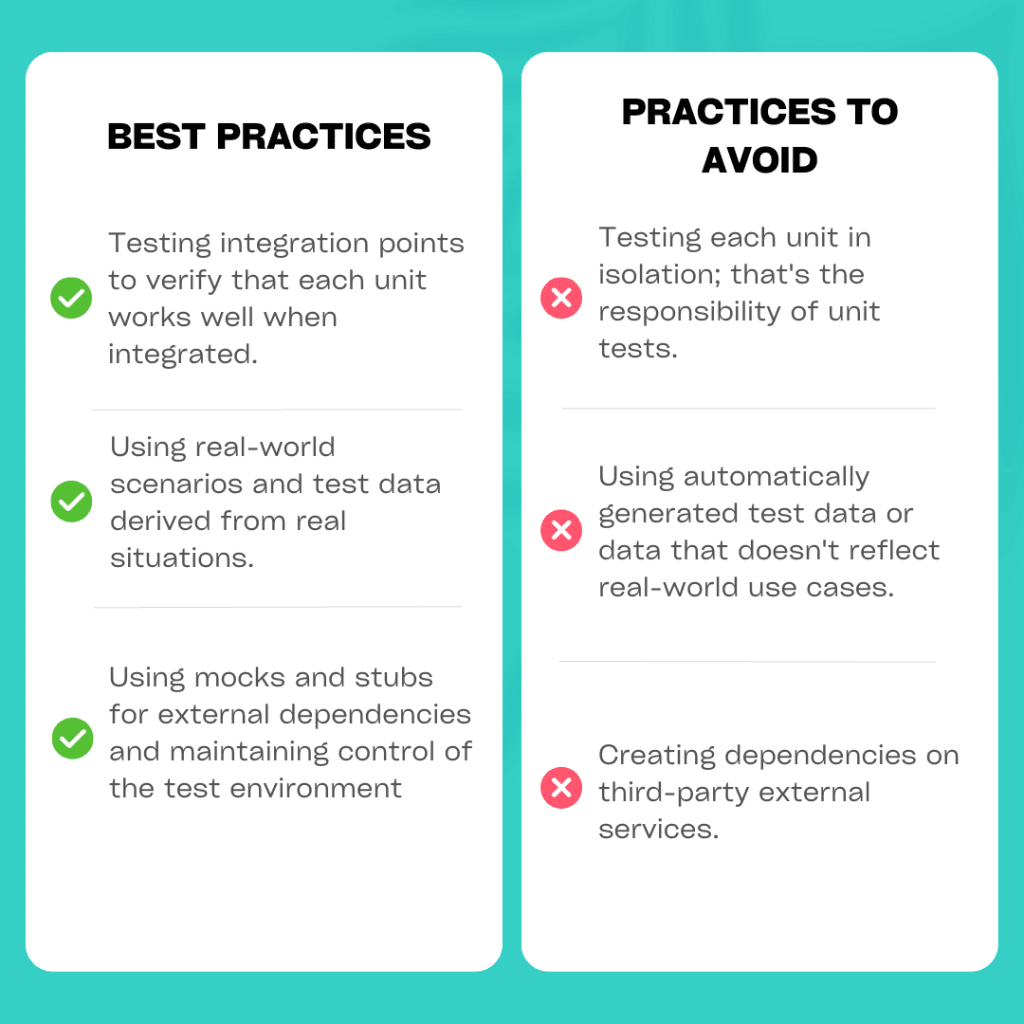
Characteristics of a Good Integration Test:
To simulate interactions between components and cover real-world scenarios, it’s advisable to use simulations (mocks or stubs). Additionally, considering component performance is crucial to ensure they function correctly under high load.
End-to-End Testing
End-to-end tests simulate the entire software flow from the end user’s perspective. They focus on identifying potential issues users might encounter while interacting with the overall application flow. These tests cover sections that unit and integration tests do not.
- To complete an end-to-end test, the following steps are required:
- Analyze software requirements.
- Prepare the test environment considering hardware and software requirements.
- Understand the system and subsystems.
- Define the methods needed to test all responses from the previous step.
End-to-end tests have the advantage of validating the system’s functionality and performance as a whole, along with the integrity of shared information between components. However, they also present some challenges such as complexity, time, cost, and dependency on other external factors.
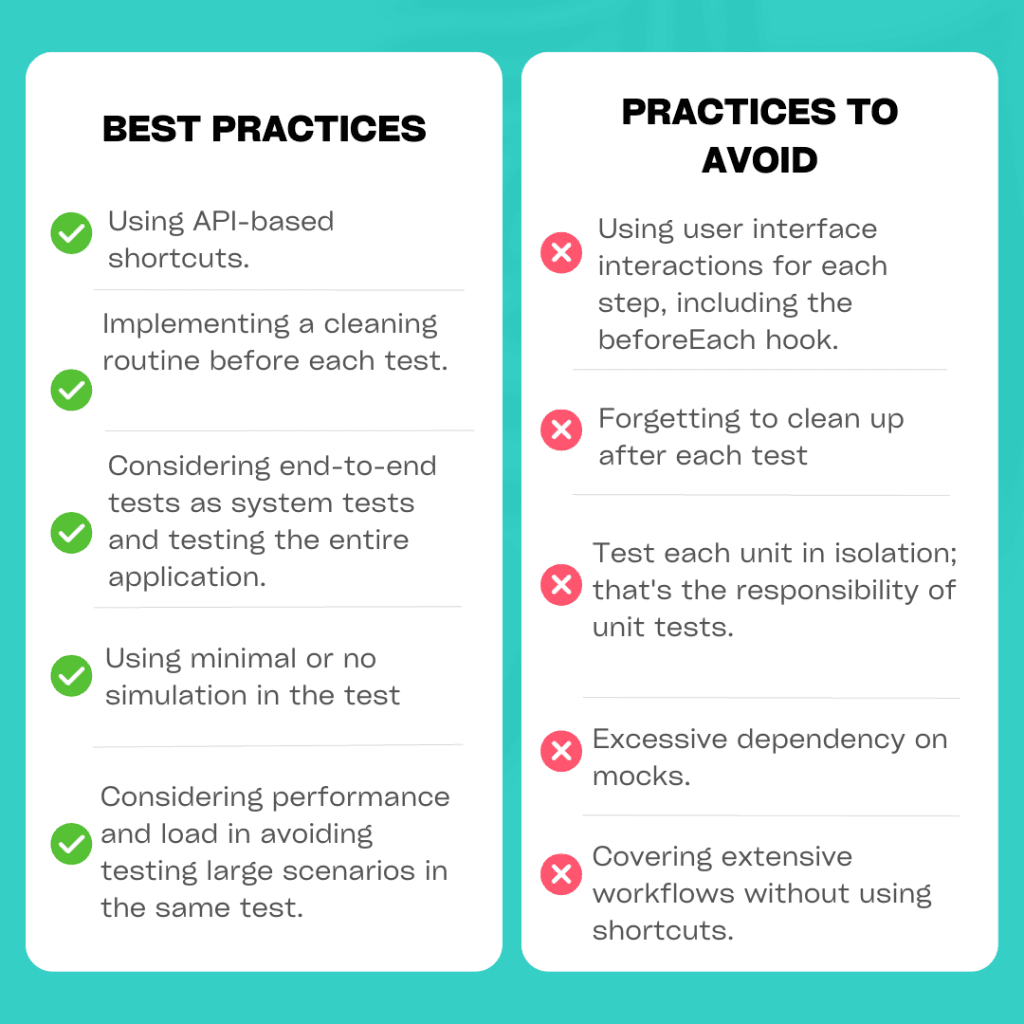
Characteristics of a Good End-to-End Test:
To ensure comprehensive test coverage, it’s important to replicate user interactions and encompass multiple layers. Including vital scenarios and handling asynchronous operations are recommended practices. Verifying results and considering component performance are equally important to ensure they function correctly under high load.
In Conclusion: Toward Solid and Reliable Development
These strategies and guidelines not only offer a solid framework to enhance testing quality and effectiveness but also serve as pillars for more solid and reliable software development.
The key lies in simplicity, relevance, and a clear understanding of tests from the outset. By adopting these approaches, the path is paved toward software development where wise testing selection becomes the compass guiding toward success.
Do you have questions, need guidance, or want more information? Contact us.