
SaaSpocalypse: Why Salesforce, SAP and Atlassian Fell Up to 57% in 90 Days
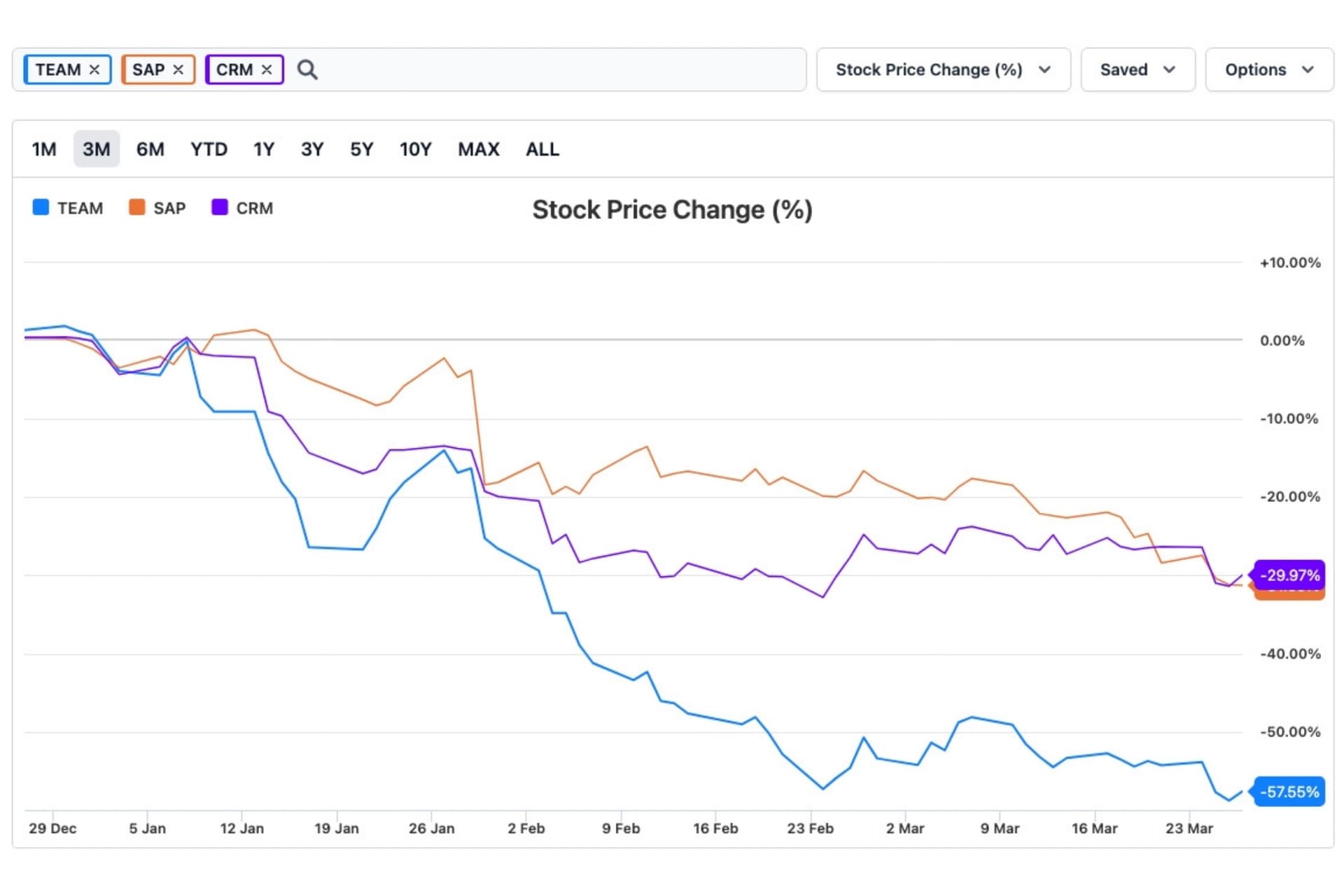
The SaaSpocalypse is the sharp decline in stock valuations of major enterprise software vendors driven by the rise of artificial intelligence agents. Between December 2025 and March 2026, Salesforce lost 21.49% of its value, SAP 29.62%, and Atlassian 56.28%. This is not a one-off market correction. It is a signal that the per-user software licensing business model is being structurally challenged by AI.
This is not a prediction. It has already happened. And financial markets, which price in the future before it arrives, have already decided who the losers of this transformation are.
What Is the SaaSpocalypse?
The SaaSpocalypse describes the threat that AI agents pose to enterprise software. The per-user licensing model, a pillar of SaaS for decades, is being structurally challenged.
The SaaS model was built on an implicit premise: automating complex processes is difficult, expensive and slow, so it makes more sense to pay a specialist vendor. That premise is no longer valid. An AI agent can today automate entire processes that previously required five or six-figure annual software licences — and do so at a fraction of the cost.
The Numbers Behind the Stock Market Collapse
The declines recorded in the first months of 2026 speak for themselves:
Company | Stock decline (90 days) |
|---|---|
Salesforce | -29.97% (3M) |
SAP | -31.30% (3M) |
Atlassian | -57.55% (3M) |
Source: StockAnalysis.com · Data as of March 2026 · 3-month change.
A complementary indicator confirms the scale of the shift. Daily installations of AI tools in VS Code, the world’s most widely used development environment, have grown from 2,000 in 2022 to 90,000 in 2026. Investors have read this signal correctly: the enterprise software market is being transformed at its foundations.
These three companies share one thing in common. Their business model is based on per-seat or per-user licensing. And that is precisely the model that AI agents are calling into question. If a company can automate with AI what previously required 10 people using Salesforce, SAP or Jira, it does not need 10 licences. It needs one. Or none.
As Jason Lemkin, founder of SaaStr, put it: “If 10 AI agents can do the work of 100 sales reps, you don’t need 100 Salesforce licences. You need 10. That’s a 90% reduction in seat revenue for the same business output.” Financial markets have already drawn their conclusions.
Why the Per-User Licensing Model Is at Risk
The per-seat model is structurally vulnerable to AI for one core reason. Its value rested on the fact that automating processes without standard software was too costly and slow for most organisations. AI removes that barrier across three dimensions simultaneously:
Cost. Automating a complete process with a custom AI agent today costs significantly less than a standard software licence for the same process. And the gap will keep widening.
Speed. With AI integrated at every phase, building software tailored to your organisation now takes weeks, not months. The argument that “building in-house is too slow” is no longer valid.
Customisation. Standard software forces organisations to adapt their processes to the product. Custom software adapts precisely to how the organisation works, without the constraints of an external vendor.
The New Paradigm That Makes It Possible
The new AI-powered software development paradigm opens up three possibilities that were previously out of reach for most organisations:
Process Automation with AI Agents — Fully Custom
Autonomous AI agents can execute complete processes without standard software licences: incident management, internal approvals, data analysis, customer service, and more. The cost sits well below the traditional licensing model.
Software Built Specifically for the Organisation
Building custom applications to cover vertical processes becomes fast and viable. This directly challenges the value of paying to customise standard software while accepting its price, speed and vendor dependency limitations.
Proprietary SaaS Products and New Customer Experiences
The time and budget constraints that previously blocked organisations from building their own digital products have disappeared. Companies that could not previously afford to build their own digital products can now do so in weeks.
What the SaaSpocalypse Means for a CIO
For a Chief Information Officer, the SaaSpocalypse means revisiting the technology stack with one concrete question: which licences are we paying for simply because there was no viable alternative before?
Organisations that answer this question with clarity in 2026 will gain competitive advantage. Those that wait will pay the cost of the transition rather than leading the change.
Three Concrete Actions for a CIO Facing the SaaSpocalypse
- Audit the current stack by identifying which tools could be replaced by custom AI-built software — at lower cost and with greater personalisation.
- Evaluate a pilot project to measure the real cost and speed differential between the licensing model and AI-powered development for a specific use case within the organisation.
- Position the decision strategically before the board: this is not a technical decision, it is a competitiveness decision that affects the company’s cost structure and capacity for innovation.
The risk is not adopting AI too soon. The risk is not doing it in time.
Frequently Asked Questions About the SaaSpocalypse
What exactly is the SaaSpocalypse? The SaaSpocalypse is the disruption of the enterprise software market caused by the rise of AI agents, which threaten the per-user licensing business model by making custom process automation viable at a lower cost.
Why did Salesforce, SAP and Atlassian shares fall? Financial markets anticipated that the per-user licensing model is vulnerable to autonomous AI agents, which can execute the same processes at significantly lower cost without the need for standard software licences.
Does the SaaSpocalypse affect all software companies? It primarily affects enterprise software vendors based on per-user licensing. Software companies that integrate AI into their value proposition, or that offer infrastructure for AI-powered development, are in a different position.
How can a company adapt to the SaaSpocalypse? Adaptation starts with reviewing the technology stack to identify licences that could be replaced by custom software, evaluating the real cost of AI-powered development versus current licence costs, and positioning the transition as a strategic decision for leadership.
What role does Itequia play in this context? Itequia is an enterprise software development and custom digital solutions company with more than 15 years of experience and over 200 client organisations. Headquartered in Barcelona and Madrid, with a team of more than 60 people, it combines three areas of expertise: innovation and custom AI-powered software, Microsoft Solutions (as a Microsoft Solutions Partner since 2010), and technology team outsourcing. Its proposition is clear: delivering software projects in weeks, not years, powered by AI.