
DTM for Celsa Group: An intuitive application to optimize team task management

For an organization the size of CELSA Group, Europe's leading producer of low-emission steel, being able to optimize its processes is key to guaranteeing the quality, safety and efficiency of its services. For that reason, the company needed a tool that would let it improve communication between teams and manage its workers' tasks in an agile and effective way, replacing its old system, which was manual and impractical.
01. The Challenge
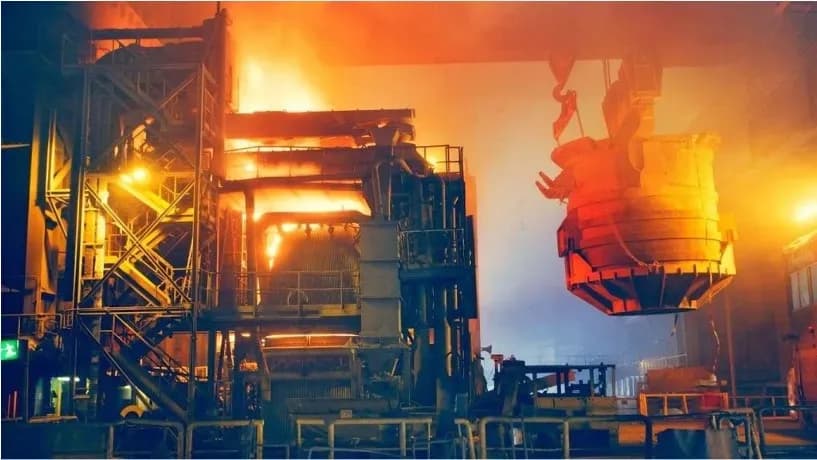
Itequia's challenge was to create a digital application adapted to the specific needs of each team and production plant and that, at the same time, would allow tasks to be assigned, monitored and escalated in an agile and efficient way.
A solution that would help improve productivity, quality and safety in its processes, thus fostering new communication habits and collaboration between the different levels and areas of the organization. And, therefore, the achievement of the standards of order and work set by the company. In this way, a much more consolidated team focused on continuous improvement goals is created.
02. The Solution
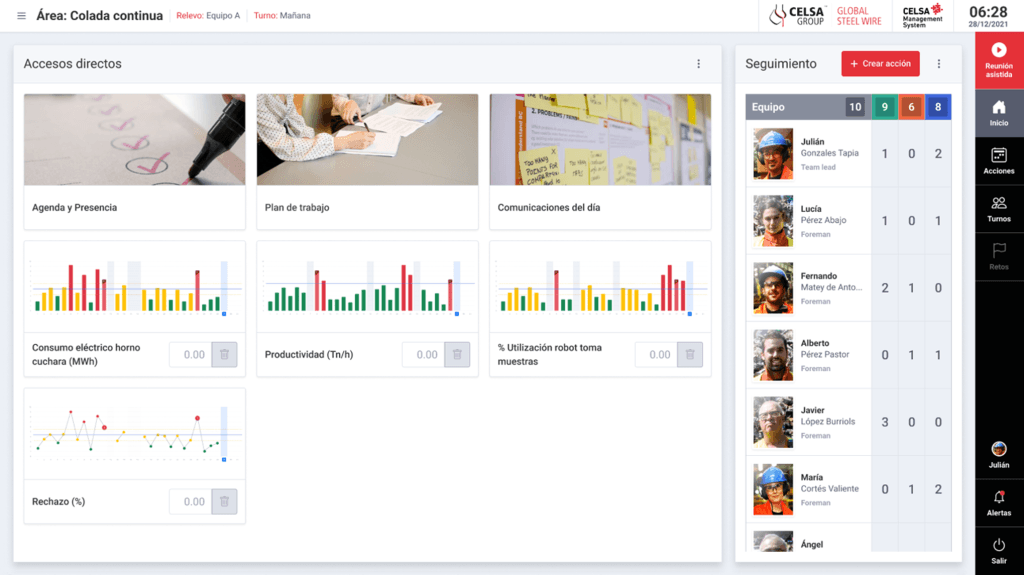
With the aim of offering a competitive solution, the requirements defined by CELSA were followed exhaustively. This allowed us to develop the interactive and innovative solution they were looking for: DTM (Team management).
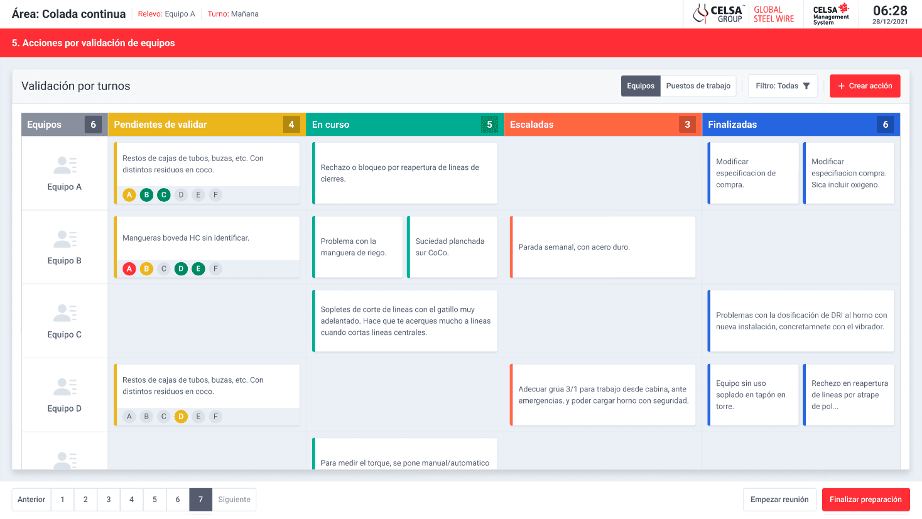
With DTM, the physical whiteboard used by the company was digitized. In this new digital version, the “post-its” have become digital cards that are easy to move, making it easier to assign, escalate and reassign tasks between teams and the shifts that cover the work rotations.
The solution also makes it possible to carry out daily tracking of indicator values that can be configured, in order to record actions to be taken when an indicator deviates from its target.
Another DTM feature is the possibility of creating 5S Challenges at team level, with the idea of achieving specific goals through the actions that are assigned. In 5S Challenges, an initial photo is taken of the work zone or area to be improved and, once the challenge has been achieved with the proposed tasks or actions, the "after" photo showing the final result is added.
We can state that the application has solved several organizational problems that existed between the different teams and shifts at CELSA's production plants, positively transforming the way workers' tasks are managed and the communication between them.
Technology
03. Highlights
DTM has brought a significant improvement in task management at Celsa's production plants, by replacing physical whiteboards with digital screens.
It has increased the productivity, quality and safety of processes, by making it easier to assign, monitor and escalate tasks.
It has improved communication and collaboration between the different levels and areas of the organization, by allowing information and files to be shared in real time.
It has reduced the consumption of paper and other materials, by digitizing notes and post-its.
Do you want to digitize task management for your teams?
We can help you develop a custom application that replaces manual processes with agile and efficient tools. Tell us about your case